Dear Claire,
I've never met you, but I feel like I have. Yesterday I read and retweeted a bunch of your quotes #treatyed #ecs210
I wish I could have been there to hear you say that we don't have to be experts to be treaty educators. That teaching treaty is not about teaching culture. That First Nations people are diverse. That treaties call us to share the land.
I really needed to hear you say that mistakes make room for us to grow.
I love your blog banner, "We Are All Treaty People" and I celebration your mission statement:"An ongoing quest to bring treaty education to the classroom." treatypeople.edublogs.org
I teach grade nine and ten English in Fort Qu'Appelle in the heart of Treaty Four. Did you come to the September Gathering this past fall? Maybe next year our classes could meet up, or do a joint project.
Maybe your kids would like to see our blog www.thefoxattreaty4.blogspot.com. We also did a lot of tweeting @thefoxattreaty4
Hope to meet you soon!
Sincerely,
Sheena @TreatyWalks
Tuesday, November 25, 2014


Sunday, November 23, 2014
Sunday to Sunday Treaty Walking
Today we meet at my cousins' home on Craigleith for Sunday Circle. We share our struggles, we share our hope. We laugh, we pray, we cry. We hold each other's children. We encourage one another with scripture. First Nation and Settler, we are learning to be in one another's homes. We are trying to walk humbly like Jesus.
Today our circle went as far as Pasqua First Nation and as close as a small house across the tracks where a broken brother told my husband and I, "they'll call the cops on us, they'll take our money, but they won't be our friends."
It's time for that chapter to be over. It's time to learn to be family, brother-to-brother, like those visionary old ones spoke into Treaty.
Every day I walk this town, teach in our community school, drive through the heart of Treaty Four to my home in the hills. Every day is an opportunity to build relationships. From Sunday to Sunday I reflect on these relationships. I consider promises and broken promises. I remember blessings and oppression. I realize the riches we have to share back and forth, First Nation and Settler, our old teachings and sacred verses guiding us. I step closer into the circle.
Saturday, October 11, 2014
So Much Hope. So Much Beauty.
My grade nine students are zipping up binders, pushing in chairs, and spilling from my new classroom. I go to the back of the room and pull a box from the lowest shelf. It's heavy, full of shiny magazines, Kitoskayiminawak Pikiskwewak: Our Young People Speak: The Treaty Edition. We sold quite a few this summer at the Treaty 1-11 Gathering in Fort Qu'Appelle, and now University of Regina Professor Michael Cappello has wiped out my supply, ordering thirty-five to use in his education class. I am delivering the magazines to Houston's because Mike and some of his education students are driving to Fort Qu'Appelle to pick them up. They have invited me out for lunch, too, to talk about Treaty Education.

Students reading their 2014 magazine at spring Gala Book Launch
The sun is shining, the leaves are crisping yellows and orange. It's only nine degrees, and if it was a bit warmer, we would have met at Treaty Four Park. I lug the heavy box into Houston's, and there sit five young women and professor Mike. After quick introductions we begin our conversation. They explain the purpose of their trip, to open up a space in which they can continue their dialogue and dream to form an Anti-Oppressive Education Club at the UofR and to meet me. We order; I get a small salad, because I will be doing a lot of the talking.
The students tell me that they've read some of my blog in one of their classes, and I ask if they notice I've stopped blogging. "I wasn't going to mention that," says Mike.
I tell my story of growing up on a farm, teaching one year at Luther College, then living and teaching on a reserve in Black Lake First Nation, Treaty 8 Territory, then moving south, back into Treaty 4 Territory where I was born and raised, all the while, not realizing the significance of Treaty in my own history as a settler descendant.
The meals begin appearing. "This is so much," they say about the large portions.
"I should have warned you," I say.
I tell of my Treaty awakening. How I started Treaty Walking. How I was tired of alienating people when I tried to talk about anti-racism. How I thought maybe blogging and doing something weird, like walking to school for 200 days, might give me opportunity to share what I'm learning in a good way.
I take a bite of my grilled chicken. I dip it in the house salad dressing. Mmmm.
I put on another hat, President of the Dr. Stirling McDowell Foundation for Research into Teaching, and I pull handouts from my briefcase about Action Research, left over from an inservice last week. I tell them that Action Research is a way of being: questioning, acting, reflecting, and then cycling through a new question, new action, new reflections. Treaty Walks have been informal Action Research. I suggest their group might be interested in applying for a McDowell Grant. They talk amongst themselves, and I crunch on my salad.
I start whispering, telling them about being in Italy this summer with my husband and taking a Creativity Workshop in Florence and how we used stage whispering to share our writing with our whisper partners. I tell them, I want to whisper something to you. Everyone leans in. I tell the young women and my friend the professor about conflict I have every year with a few students and a few parents when I take the students to the Treaty Four gathering. I tell them that I get my hand slapped regularly.
"They are disciplining you," says Mike.
I confess that I often feel sorry for myself, but how I recently, finally, viewed one of the Blue Eyes, Brown Eyes sessions with Jane Elliott (because my husband sat me down and said, "you need to watch this"), and how my life is very blessed and privileged, and nobody should be feeling sorry for me because of my little bit of activism and occasional figurative slaps.
I tell them how my husband is coaching me that I need to perfect my discourse. I am great at creating awkward, uncomfortable spaces in which anti-racism conversations can take place, but I don't know how to "nail it in" as Jane Elliott would say. I tell them that I have about ten years left in me as a teacher and that maybe these will be my best years, but I have lots of learning to do.
"See, look at her, she's been teaching a long time and she doesn't know the answers," Mike says, and smiles at me. I nod.
"So remember that you don't need to know all the answers when you think you need to know the answers," he says.
I tell them that every day since I stopped blogging -- seriously, every day -- I have had a two hour blog topic on my mind and in my heart. I have been overwhelmed. I have been burned out. But I have taken some time for renewal and the energy is returning. This luncheon is part of my recharging.
We are finishing our lunches, or all we can eat, and asking for doggy bags. We sip water, talk about the SAFE Conference in Regina that we will all be attending October 24th dedicated to Anti-Racism and Anti-Oppressive Education.
I wish I had time to take them on a quick tour of Fort Qu'Appelle, but they will drive around on their own, and they really want to see the school. Mike takes the cheque and we leave.
We walk the hallways at Bert Fox Community High School, and I'm seeing my students through these young educator's eyes. So much hope. So much beauty.

Monday, May 26, 2014
Seasons
I remember walking this valley as green blooms, morning to morning
as heat pounds and the shade is cool like wading in the lake
as leaves crunch in the gravel at my feet
as snow blows, turning the hills white
I remember walking and breathing air
soft, heavy, fragrant, harsh
breathing deeper and harder
as minutes turn to hours
breathing deep and simple
as hours turn to days
breathing
Eight weeks ago I stopped walking
"you can get crutches at the pharmacy" she'd said
and that was that
no more walking
with a broken ankle
Two weeks ago I thought, only two more weeks
but this morning at the doctor's
"two more weeks" she says
and that is that
no more walking
Just swinging along the side-walk on my crutches
crawling up stairs on my hands and knees
hobbling in the kitchen with a chair
hopping from my bed to dresser
And I'm not sure where I'm going with this poem
"what is the lesson I should learn?" I ask
Janet, my sister-in-law, who sees me
from her office window at the All Nations Healing Hospital
and runs to open the door for me
"More and more I'm learning that life is about seasons,"
she says after we've talked about my Moira and Victoria's drama
at the Cathedral Village Arts Festival
and little Lanelle not closing the pen
letting loose the sheep and llamas on the lawn
We stand in the sunshine outside the hospital
Janet on two feet, me on my crutches
talking about newborn lambs
and the kindness of nurses and doctors
While people of all nations are breathing by us
each in his or her own season
even as the spring earth is ploughed for flower beds
beside the emergency doors of the hospital
Wednesday, October 23, 2013
This Town Talks to Me
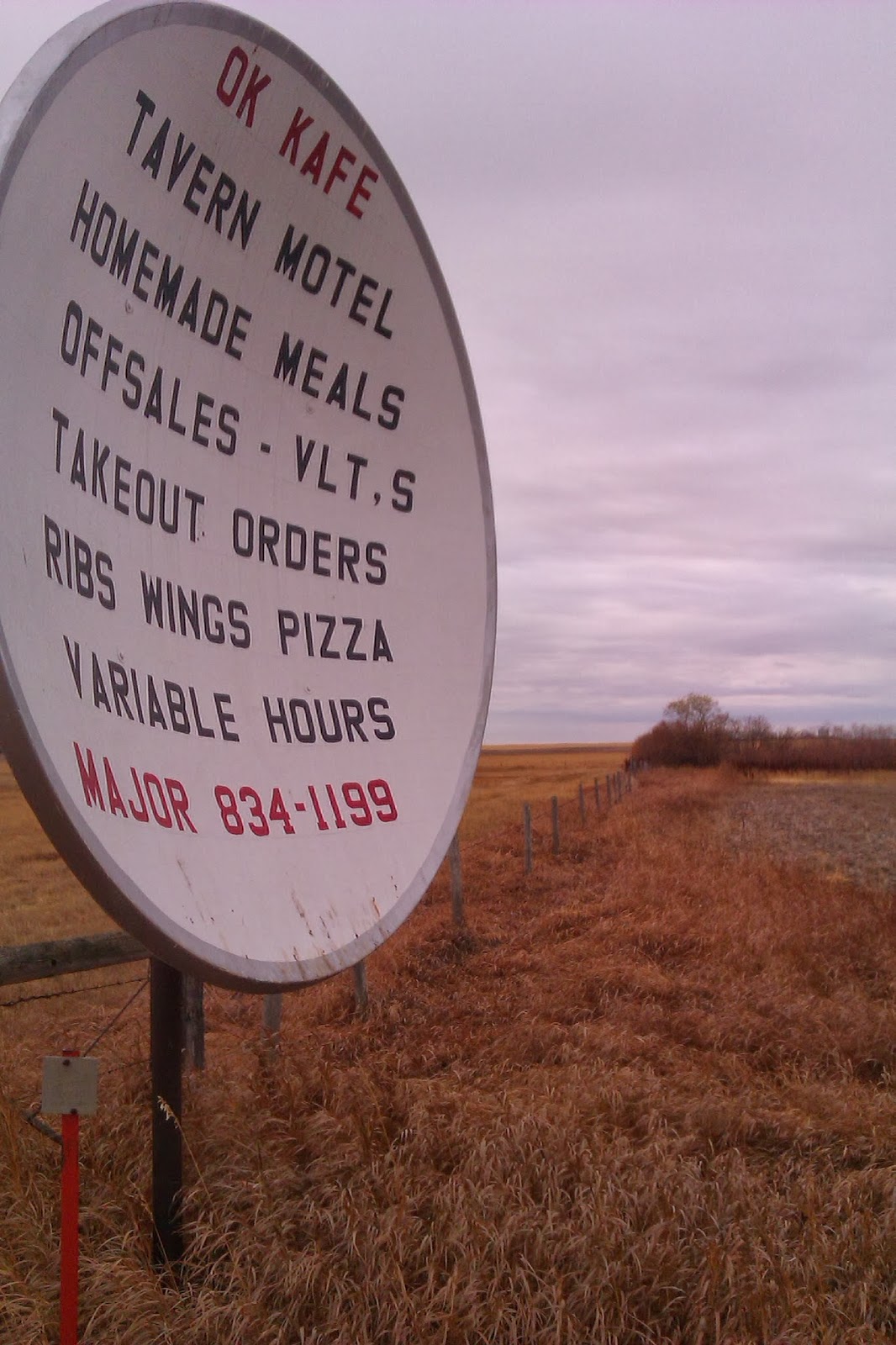
Near midnight, I am invisible behind my headlights after six hours driving west accross the prairie. There is one light on in Major, Saskatchewan. Rona and John take me in, make Earl Grey tea and send me to bed.
I wake too late to treaty walk the town, so I treaty drive, get out to take pictures, hop back in. It's fall. It's cloudy. Winter is on its way.
"This town has stories," I say in my opening remarks to Major School as they celebrate Saskatchewan Library Week. "Just look at your street signs. They're talking. If I could rent a house here I could write for a month, even longer, and I'd be so happy. This town reminds me of Macoun where I went to school. I feel like an artist at home in your town."
These young people, kindergarten to grade twelve, fit into one classroom. I tell stories of my own, about living in Northern Saskatchewan Black Lake, writing about Southern Saskatchewan home. They listen and smile in just the right places. I read from my novel, Voice of the Valley. I share my Treaty Walks blog.
"What an honour it is to be with you today," I say. "This is a tough year as you prepare to say goodbye to your school." I dedicate and sing two songs to this community in transition: one remembering my grandfathers who took different paths during the war, and a second which begins, "There's a tree on the prairie, alone under the sun. Branches waving, leaves a shaking, cause her roots won't let her run."
As I drive away, knowing Major for under twelve hours, I am in mourning. I've heard this story before. The grey sky and damp earth sympathizes with the collective wisdom: a community dies when it looses it's school.
As I drive away, there are two treaty narratives trailing behind me. The first narrative I know well. It's the settler narrative. My people came to this land (peacefully because of the treaties signed with the first people.) We set up house on the land. We farmed and raised families. We built communities.
The second narrative, the Indigenous narrative, I am still learning to hear. The people lived complex and sophistocated lives on this land. They welcomed newcomers. They made treaties to share the land. Then, most of the land was taken away. Their way of making a living, interrupted, and changed forever. And then the children were taken away. The Indigenous narrative knows a thing or two about loss.
As I drive away, I wonder if settler descendant loss might cultivate empathy and solidarity with those who have lost before us.


Thursday, October 10, 2013
Treaty Walking with Sue and Lanelle
Sue drove into my yard around seven this morning. We've made a Treaty Walk date. She parks her car, meets me on my front steps. We hug, smile, laugh, and start walking down the lane.
What's new with you? Bla, bla, bla, says Sheena.
And how about you, Sue?
Sue Bland, artist and community dreamer, has been researching Treaty Four park. I have goose bumps as Sue tells me about what she's been learning from the Saskatchewan Archives.
A Volkswagen crunches to a stop on the gravel. It's my sister-in-law, Janet. All three little smurfs are tucked into the back seat. We chat about Janet's community cooking classes, making chicken lasagna this past week and how much fun folks are having.
Kellen has climbed into the front seat. Neve is strapped beyond her control. Janet tells Lanelle she can walk with us, and Mommy will pick her up once she's dropped off Kellen at Auntie's house. Lanelle jumps out and we start walking.
Pretty much a perfect morning in the yellow-leaf morning, sun rising behind the clouds. I'm holding my neice's hand, treaty walking.
What will the next generation learn about walking together on this land? What will the next generation teach us about getting along together?
#nextgenerationtreaty4pride


Sunday, October 6, 2013
Sunday Morning Ride
side-by-side through swathed stubble
the four legged carry
settler-decendant-farm-girls
(ages 17 and 46)
talking about Lord of the Rings,
writing spaces, hashtag poetry,
and what it is like
with blonde hair
riding Getty in the treaty four parade
this year cantering by invitation
into the arbour at the pow wow grounds
horse hooves and healing
circles within circles
#thankyouforsharingtheland
#treaty4beauty
#nextgenerationtreaty4pride
#horsebuddies
Marina saddling her horse, Getty, for me.
Marina on her sister's horse, Missy.
Me and Getty
Missy and Getty walk side-by-side
shadows past, present, future
Subscribe to:
Posts (Atom)