Monday, May 26, 2014

Seasons

I remember walking this valley as green blooms, morning to morning
as heat pounds and the shade is cool like wading in the lake
as leaves crunch in the gravel at my feet
as snow blows, turning the hills white

I remember walking and breathing air
soft, heavy, fragrant, harsh 
breathing deeper and harder
as minutes turn to hours
breathing deep and simple 
as hours turn to days
breathing

Eight weeks ago I stopped walking
"you can get crutches at the pharmacy" she'd said
and that was that
no more walking
with a broken ankle

Two weeks ago I thought, only two more weeks
but this morning at the doctor's 
"two more weeks" she says
and that is that
no more walking

Just swinging along the side-walk on my crutches
crawling up stairs on my hands and knees
hobbling in the kitchen with a chair
hopping from my bed to dresser

And I'm not sure where I'm going with this poem
"what is the lesson I should learn?" I ask
Janet, my sister-in-law, who sees me 
from her office window at the All Nations Healing Hospital
and runs to open the door for me

"More and more I'm learning that life is about seasons,"
she says after we've talked about my Moira and Victoria's drama
at the Cathedral Village Arts Festival
and little Lanelle not closing the pen
letting loose the sheep and llamas on the lawn

We stand in the sunshine outside the hospital
Janet on two feet, me on my crutches
talking about newborn lambs
and the kindness of nurses and doctors

While people of all nations are breathing by us
each in his or her own season
even as the spring earth is ploughed for flower beds
beside the emergency doors of the hospital

Wednesday, October 23, 2013

This Town Talks to Me

Near midnight, I am invisible behind my headlights after six hours driving west accross the prairie. There is one light on in Major, Saskatchewan. Rona and John take me in, make Earl Grey tea and send me to bed.

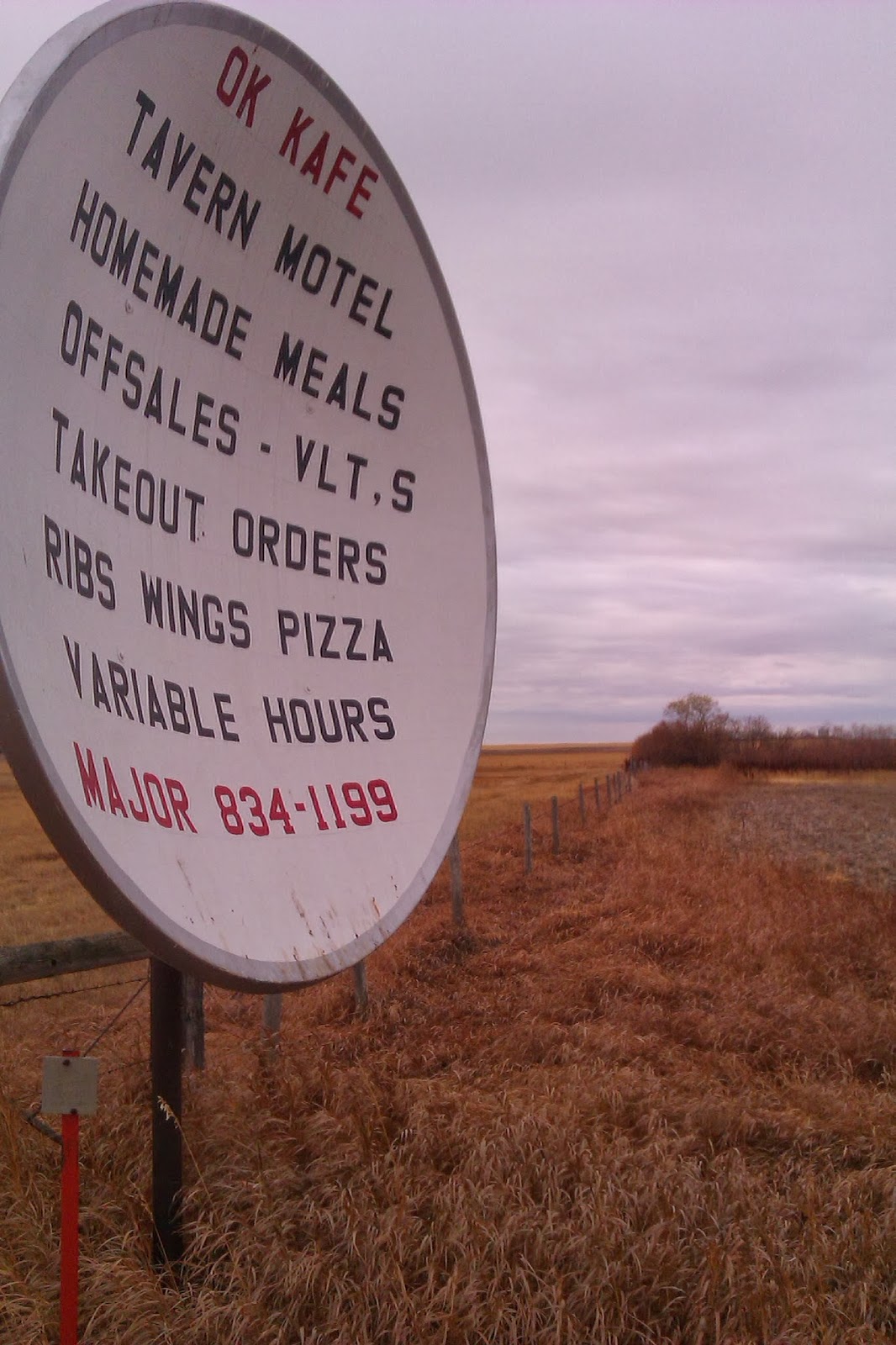
I wake too late to treaty walk the town, so I treaty drive, get out to take pictures, hop back in. It's fall. It's cloudy. Winter is on its way.

"This town has stories," I say in my opening remarks to Major School as they celebrate Saskatchewan Library Week. "Just look at your street signs. They're talking. If I could rent a house here I could write for a month, even longer, and I'd be so happy. This town reminds me of Macoun where I went to school. I feel like an artist at home in your town."

These young people, kindergarten to grade twelve, fit into one classroom. I tell stories of my own, about living in Northern Saskatchewan Black Lake, writing about Southern Saskatchewan home. They listen and smile in just the right places. I read from my novel, Voice of the Valley. I share my Treaty Walks blog.

"What an honour it is to be with you today," I say. "This is a tough year as you prepare to say goodbye to your school." I dedicate and sing two songs to this community in transition: one remembering my grandfathers who took different paths during the war, and a second which begins, "There's a tree on the prairie, alone under the sun. Branches waving, leaves a shaking, cause her roots won't let her run."

As I drive away, knowing Major for under twelve hours, I am in mourning. I've heard this story before. The grey sky and damp earth sympathizes with the collective wisdom: a community dies when it looses it's school.

As I drive away, there are two treaty narratives trailing behind me. The first narrative I know well. It's the settler narrative. My people came to this land (peacefully because of the treaties signed with the first people.) We set up house on the land. We farmed and raised families. We built communities.

The second narrative, the Indigenous narrative, I am still learning to hear. The people lived complex and sophistocated lives on this land. They welcomed newcomers. They made treaties to share the land. Then, most of the land was taken away. Their way of making a living, interrupted, and changed forever. And then the children were taken away. The Indigenous narrative knows a thing or two about loss.

As I drive away, I wonder if settler descendant loss might cultivate empathy and solidarity with those who have lost before us.


Thursday, October 10, 2013

Treaty Walking with Sue and Lanelle

Sue drove into my yard around seven this morning. We've made a Treaty Walk date. She parks her car, meets me on my front steps. We hug, smile, laugh, and start walking down the lane.

What's new with you? Bla, bla, bla, says Sheena.

And how about you, Sue?

Sue Bland, artist and community dreamer, has been researching Treaty Four park. I have goose bumps as Sue tells me about what she's been learning from the Saskatchewan Archives.

A Volkswagen crunches to a stop on the gravel. It's my sister-in-law, Janet. All three little smurfs are tucked into the back seat. We chat about Janet's community cooking classes, making chicken lasagna this past week and how much fun folks are having.

Kellen has climbed into the front seat. Neve is strapped beyond her control. Janet tells Lanelle she can walk with us, and Mommy will pick her up once she's dropped off Kellen at Auntie's house. Lanelle jumps out and we start walking.

Pretty much a perfect morning in the yellow-leaf morning, sun rising behind the clouds. I'm holding my neice's hand, treaty walking.

What will the next generation learn about walking together on this land? What will the next generation teach us about getting along together?

#nextgenerationtreaty4pride


Sunday, October 6, 2013

Sunday Morning Ride

side-by-side through swathed stubble
the four legged carry
settler-decendant-farm-girls
(ages 17 and 46)
talking about Lord of the Rings,
writing spaces, hashtag poetry,
and what it is like
with blonde hair
riding Getty in the treaty four parade
this year cantering by invitation
into the arbour at the pow wow grounds

horse hooves and healing
circles within circles

#thankyouforsharingtheland
#treaty4beauty
#nextgenerationtreaty4pride
#horsebuddies


Marina saddling her horse, Getty, for me.
 
Marina on her sister's horse, Missy.
 
Me and Getty
 
Missy and Getty walk side-by-side
 
shadows past, present, future

Sunday, September 29, 2013

Still Waters

I'm walking along the sandy path, skirting Little Manitou Lake. The morning is quiet. The water is reflecting the sky. I am walking, but I keep stopping to take pictures.

My friend, Alfred Cyr, told me that the elders told him, "If you don't know how to pray, walk. Then you'll learn how to pray."

I haven't been walking much, maybe a couple times a week. But today, on this morning walk along the still water named for Spirit, Manitou, I am praying with each step. How do I continue my treaty walks? What have I learned from the Idle No More movement? What's next?

I haven't been walking much, and I haven't been blogging at all, yet everyday that I haven't written, I've still been learning about land, people, history, promises, brokenness, healing, dreams, and hope. I've realized I can't keep up, so I've stopped trying.

This past summer, Michael, my husband, was sharing the story of Jonah and the great fish from our sacred teachings. He said something that's really made me think. Usually, when we're running from something, that's the exact thing Creator wants us to do.

I'm still at Manitou Beach, but today the wind is blowing and the sky is cloudless. I'm sitting on a rock along the shore, the sun is full and hot. I'm wondering, what am I running from?

A pelican, white and wobbly in the wind, circles in the blue. Dry, orange leaves trot on the pavement behind me, then down the rocky shore. A gust of wind turns a swath of water dark blue, like a hand moving, creating a shadow in it's path. The hand moves here and moves there.

Silence. You're running from silence.

Would it be ironic to break the stillness on my blog by realizing I'm afraid of quiet? Scared of rest. Scared of time to process.

to rejuvinate
to think
to be
to share in a good way


And when I walk and then rest, I will hear Great Spirit whisper, as I did this weekend on the shores of Little Manitou.

Thursday, June 20, 2013

I Still Remember Treaty Walks Password


It's been twenty days since I posted on my Treaty Walks blog. I was almost afraid that I'd forgotten the password. Every one of those twenty undocumented days has taught me something new about treaty, in fact, I'm overwhelmed; I could write for two, three, four hours every day. In fact, I should write that long to truly honour the significance of Miyowicehtowin,Witaskewin, and Pimacihowin:
to honour this land where we are getting along, living together, making a living.

But right now, I don't have two hours a day. So, what do I do?

I can facebook Sue and Kate. Help?

I can text Char. <3

I can watch my daughter walk across the graduation stage wearing her grad gift, moccasins from Black Lake.

I can make coffee for a meeting today after school as we consider applying for a McDowell Foundation for Research into Teaching grant.

I can have a coaching session with Kevin.

I can go on a road trip with Val, Melissa, Tami and Jade to the Black Hills and listen to Martin Brokenleg talk about the Circle of Courage.

I can take a deep breath and keep walking.

Photo: Opening my Mum's grad gift. A beautiful pair of moccasins from Black Lake. They even smell right! I bawled.


Photo

Friday, May 31, 2013

"We Are Getting Our Stories Back" She Says

Sandy stands at the microphone in the Governance Centre's inner circle. She has just made a short speech, thanking everyone for their contributions to this year's magazine, Kitoskayiminawak Pikiskwewak Our Young People Speak: The Healing Edition. She downplays her role, but as Lesley Farley and Michelle Hugli Brass have just said, "Sandy is a visionary." In fact, she is the one who has brought us all together.
 
Sandy has just mentioned a couple more thank you's and then, her voice fails. Sandy pauses. "We are getting our stories back," she says.
 
A few months ago, I asked Sandy if I could publish excerpts from her thesis on my blog. She graciously said yes.
 
Sandy is a story keeper. Here is the beginning.


"ECHOES OF VOICES FROM A LONG TIME AGO":
A SELF-REFLEXIVE JOURNEY OF UNDERSTANDING LEADERSHIP
FROM A PERSONAL AND INDIGENOUS PERSPECTIVE
A Thesis
Submitted to the Faculty of Graduate Studies and Research
In Partial Fulfillment of the Requirements
For the Degree of Master of Education
Educational Administration
University of Regina
Sandra L. Pinay-Schindler
July 2011
Copyright 2011: S.L. Pinay-Schindler
 
 
Abstract

The personal journeys of First Nations Elders and leaders provide insight into
moral and ethical leadership and have implications for First Nations and Western
leadership models. Examining and defining how First Nations leaders find balance and
guidance in challenging situations was the purpose of this leadership study. As the data
was analyzed and synthesized, the findings emerged as a self-reflexive narrative. The
study revealed that Indigenous methods and concepts were vital to this culturally
respectful and significant research journey.
The First Nations experience in Canada is complicated and there are historical
impacts from a colonial presence and oppressive government acts (Episkinew, 2001). The
social and leadership structure of most First Nations communities has been negatively
impacted. Contemporary First Nations leaders appear to strive for a balance between
spiritual, moral, and ethical leadership guided by Elders and Western influences
(Ottmann, 2005). Through a combination of Indigenous and Western research processes,
it was revealed that First Nations leadership relies upon place, values, and relationships to
sustain moral and ethical balance. The Indigenous concept of place was significant. The
leaders situated themselves in the collective and in relation to others, both physically and
metaphysically. Through the Indigenous conversational method (Kovach, 2010) based on
oral tradition, the First Nations leaders revealed that their place in relation to their life
journeys, people, and personal development gave them the guidance to be strong and
humble leaders. A spiritual, mental, physical, and emotional connection to Turtle Island,
our First Nations ancestors, and our place was vital to being a strong leader. Influences
of Elders, family, and connections to others were essential to leadership development and
sustainability. The models of servant leadership and moral and ethical leadership are
increasingly relevant to modern organizations. The roots of this model are found in
historical First Nations leadership tenets, like humility, servitude, connectivity,
i.
balance, and relationships. This is a natural, respectful leadership model that provides
opportunities for reflection, responsiveness, and adaptability.
The importance of Indigenous methods combined with Western research methods
emerged as a strong theme in this study. Culturally respectful protocol, methods, and
data interpretation were vital to the process. The value of established, trusted
relationships between the Indigenous participants and the Indigenous researcher was
significant. The Western epistemologies, data analysis, and grounded theory proved to
be useful tools for framing the initial research and analyzing the data, but the emergence
of Indigenous themes was strong. Indigenous research methods (Wilson, 2008; McLeod,
2007; Kovach, 2009) are proper and respectful of First Nations participants and
researchers to the place of their origin.


Acknowledgements

Thanking my helpers, both physical and spiritual, at both the beginning and at

the end of my thesis respects the Western and the Indigenous ceremonial protocols. I

wish to thank my co-supervisors, Dr. Linda Goulet and Dr. Larry Steeves, for their

patience, dedication, and time. They were incredibly supportive. Their viewpoints

and feedback on both Indigenous and Western methodologies and worldviews were

valued. My sincere thanks to Dr. Marc Spooner for expanding my synapses in his

introductory research class. He inspired me to explore the creative possibilities of thesis

work. It has been worth the long and winding road.

My thanks to the following organizations for funding and scholarships:

Prairie Valley School Division and the Faculty of Graduate Studies and Research for the

Aboriginal Graduate Student Scholarship, the LEADS Award in Educational

Administration, and the U of R Alumni Association Dr. John Archer Scholarship.

To my respected participants, Adlard, Flora, Julia, Grant, and Matthew, I thank

them for their honesty, trust, and generosity. They exemplify all that is grand and

powerful about First Nations leadership and I am humbled and honoured to know them. I

strive to reach the places of truth that they have attained. They are inspiring leaders.

Dedication

To my first role models: my parents, my sisters, and my brothers.

To my husband Kurt and our precious gifts, Ben and Brendan.

My parents: Emma (Crowe) & Noel Pinay Jr., Mary Immaculate Roman Catholic Church, Peepeekisis First Nation, June 17, 1946

Their hard work, sacrifices, love, and support have allowed me to find my wings and attain the educational goals they held so precious. I thank them for their incredible strength and resiliency; and for showing me that anything is possible.

My brothers and sisters: Ida, Lorraine, Dwight, Donna, Ronald, Lloyd, Debbie, Shane, Bruce, Lester, Paul, & Sandy with cousins and friends, Percival, Sk., circa 1967

I thank them for leading the way and helping me discover the joys of literature, the arts, creativity, and following the heart.

My family: Kurt and our sons

I thank them for tirelessly supporting me in this research journey. Many kilometres were driven to ski trips, appointments, and vacations while I sat in the passenger seat surrounded by books and draft papers. Their love sustains and inspires me.

Excerpt published with permission from the author.