Sunday, July 10, 2016

Four Winding Paths Up the Mountain: Historical Reading of Downtown Winnipeg

 
I am in Winnipeg with Team Saskatchewan at the 2016 Table Tennis Nationals. On Sunday I will leave the competition early, drive back to Saskatchewan and catch a plane to Vancouver for the Historical Thinking Institute. In preparation for this week long conference, one of the readings is “Teaching History from an Indigenous Perspective: Four Winding Paths up the Mountain” by Michael Marker. I am also taking pictures in and around The Bay and the Legislative Building.

 
"Pro Pelle Cutem"
 
"A Skin for a Skin"


1670
 
346 years old on May 2nd,  2016
 
200 years before Manitoba joined confederation in 1870
 
201 years before the signing of Treaty 1 in 1871
 
177 years after the 1493 Doctrine of Discovery
 
93 years before the Royal Proclamation
 
Michael Marker points out that history is most likely the most difficult class for Aboriginal students in Canada because history often has been told selectively by the dominant society and “the deeper perspectives of Aboriginal peoples in regard to their understandings of the processes of time and the principles of their knowledge systems are usually missing.” And, there are deep consequences when a story is not told correctly.
For example, what are The Bay's window dressings saying about Canada and the history of this land?

 
cloth with green, red, yellow and blue
white manikin
red tie
shiny reflection on foreground surface
frames
posters
florescent lights
from outside looking into window
 
 
rolled into log-like bundles
tied with ribbons
reds, yellows, greens, blues
reflections

 
white canoe and pillows
white, yellow, red, gree, black, blue
street scene reflection
man in red shirt
bench
 
 
I heart Canada
green, red, yellow, blue
white horns
displays on shelves
man on a bench reflected

 
white stag
faceless, white manikin
logs, skirt, yellow shirt
evergreens and borders

 
white husky
faceless, white manikins
carrying bag in blue, yellow, red and green
pom poms on white shirt
shorts and shirts of yellow under blue
boots, logs and evergreens 

 
axe and lots of chopped wood
blanket with blue, yellow stripes
cute little guy under a white hat
faceless manikin in jeanwear
framed white bird and
blue, yellow, red and green wear
with mountains in the background
Pho Hoang Vietnamese Restaurant bench in the foreground

 
white dog with blue, yellow, red, white bundle in her mouth
two deer look on from the wall
faceless manikin sees nothing at all
in her white coat, white legs strapped in high heels
carrying bags of red, green, yellow, blue

Michael Marker says there are four ways that Indigenous knowledge does not fit... into Western knowledge:

1.    Time as a circle,

2.    Relationship with the land and non-humans,

3.    The local landscape is the first way in to history making (not the global stage), and

4.    Indigenous naming of colonization and talking back to this attack.


The metaphor of Michael Marker's paper, the four paths up the mountain, always includes both a physical walk, and a more-than-physical journey. So the question is, how does a non-indigenous educator leave his or her Western mindset and travel these “intellectual trails up an indigenous mountain”?

Indigenous students will hear their elders share Creation stories, but then be corrected by well-meaning teachers, and taught the Bering Strait Theory, ironically implying that Indigenous people are also immigrants, which de-privileges their deep connections, self-constructed identities, based on the land, while also undermining sovereignty. When students are corrected by the mainstream, this has the potential of further colonizing First Nations peoples. As Marie Battiste, a Mi’kmaq scholar says, “cognitive prisons” become a form of “cognitive imperialism”.
 
United College which is also a High School one of our Table Tennis friends attended when he first arrived in Winnipeg at 17 from Hong Kong
 
Acknowledging (even privileging) a circular nature of time, rather than a linear visualization of time is the first path up the mountain. Events can spiral and reoccur. Stories can circle between or around the past, the present, the future. Perhaps the circle incorporates all times at the same time. This Indiginization de-priviliges a notion of progress so important to European worldview, in which modern society is viewed as progressive.
 
 
My student and table tennis athlete, Nigel Dubois and I toured the Manitoba Legislature.
 
 
Nigel named this the "clapping room" because echoes pop around in a circle.

Relationship and therefore knowledge with/of the land and non-humans could be where the origins of history originate in an Indigenous world. There is a “sacred ecology” and even modern understanding of Treaty and today’s landclaims would benefit if people understood how indigenous people relate and are part of the land. Often Western notions of progress are directly connected to the “sentient landscape” as Julie Cruikshank teaches us or as Marker tells us the old people say, “the land knows you’re there.” There is also the idea that “historical truth and moral and cultural truth” intertwine, and often the land, plants, animals and all non-human are involved. The place “things” happen are also integral to indigenous history. And this is becoming more and more recognized by legal systems, including the Supreme Court of Canada who recognized oral tradition as “having equivalent power with documentary evidence to demonstrate historic truth.”
 
Nigel at the park across from the Manitoba Legislative Building
 
"the land knows you're there"
 
“For indigenous communities, the past is located in the local and traditional territory” because these are the most important stories to tell for people to honour their identities and responsibility to the land. How can indigenous people communicate this truth without betraying local ways? One example is the need for Indigenous Studies or Native Studies in high schools. Without this, the dominate narrative will continue, “subordinated and shaped by the need to narrate a selective story that silences dissenting indigenous voices”. In fact, the indigenous narrative should not just be a sideline or afterthought, as Wendy Wickwire reminds us, it should be “central core of history”. This is important to identity building to fight racism, denial, stereotyping, and many more scenarios indigenous people walk with and through every day.
 
What do the words on this building tell us about worldview and relationship to the land?
  
Colonization has a long list of  pain and brings complexity to modern indigenous living. Settler descendants, learning about colonization (through the lens of colliding worldviews) have the opportunity to make a difference if willing to be part of de-colonizing because colonization is not just a thing of the past. Our society is actively practicing colonization. In fact, “For indigenous peoples, a history of Canada as a nation-state is a colonizing way of thinking about people, relationships, and the land.”
 
 
The metaphor of the paths up the mountain suggests that the one walking will need to make sacrifices. There will be sacrifices of world-view, content, time, conventions, and other discomforts or as Reagan calls it, "Unsettling"; however, the trade-off for these changes “could inspire students to imagine alternative ways to structure the societies of the future as a result of learning about indigenous ways of experiencing time and space.” Could indigenizing our history help our world become sustainable for the future?  
 
 
One of large pictures outside United College which we walked past every day on our way to the gym.
 
http://ili.nativeweb.org/sdrm_art.html on Doctrine of Discovery


Saturday, July 9, 2016

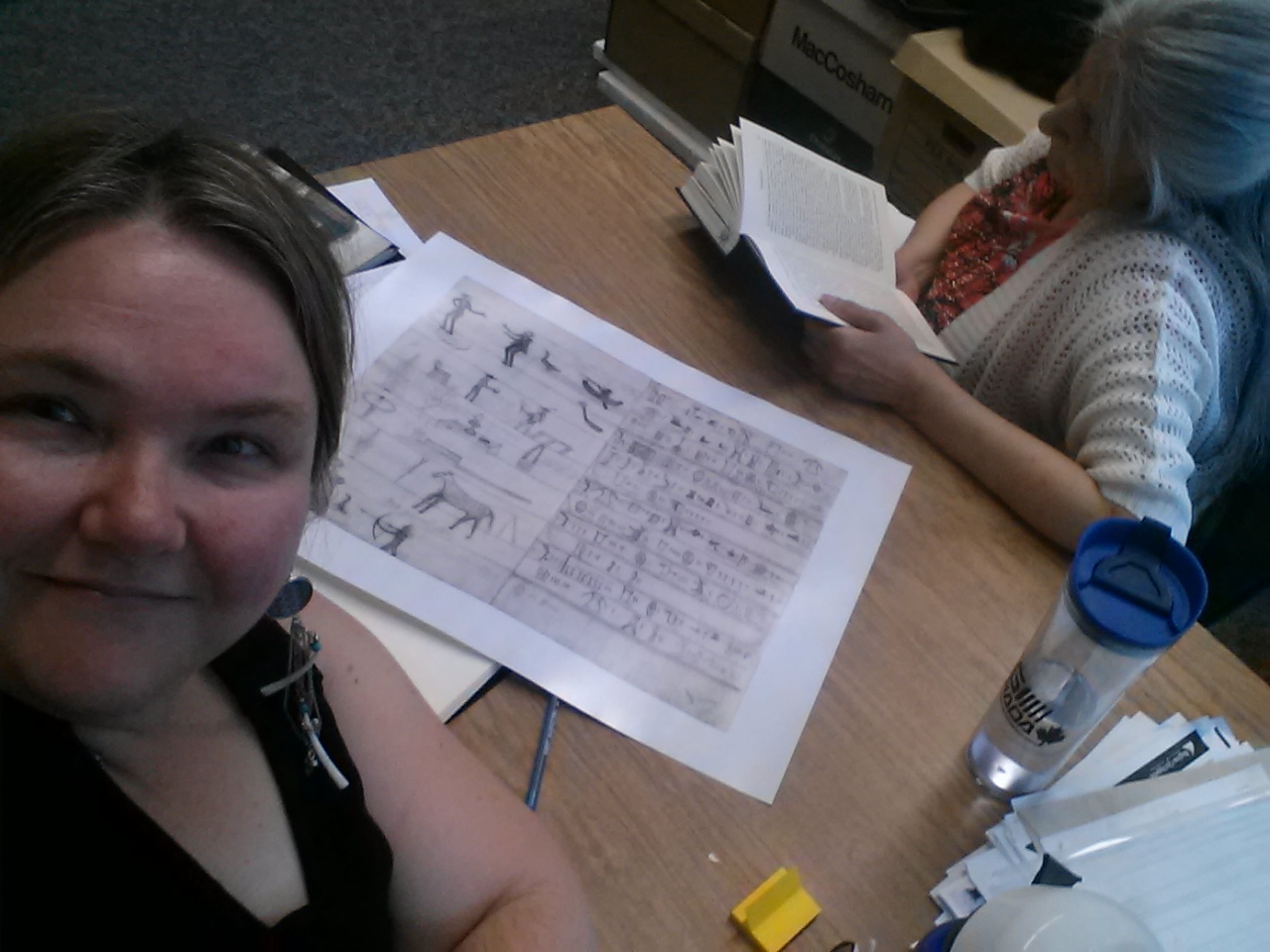
Viewing the Pasqua Pictograph with Keitha Brass

I picked up Keitha in my dusty red car and we headed for Regina. A few months ago I had phoned Dr. Evelyn Siegfried at the Royal Saskatchewan Museum because my friend, Keitha Brass, was interested in viewing the Pasqua Pictograph. Keitha is one of two remaining Great Grandchildren of Chief Ben Pasqua, one of the original signators to Treaty Four. Dr. Siegfried is the Curator of Aboriginal Studies at the museum and is currently preparing an exhibit for this rare artifact.

 
Dr. Siegfried sharing Keitha's Great Grandfather's words
from the Alexander Morris account of Treaty Four.

 
We spent almost four hours with Dr. Siegfried. She was excited to speak with Keitha because as a historian she had been thinking, where are the women's voices? At the signing of Treaties, there were camps, and if there were camps, that means the women were there. Keitha is the first woman she has spoken with in regards to the Pasqua Pictograph and also the closest living relative. 


The Pasqua Pictograph is the only Indigenous document of its kind in Canada,
conveying Treaty understanding from an Indigenous perspective.  
 
 
I am too over-whelmed with feelings to write about it yet, but I can say, sitting there with Keitha, we were living out our Treaty relationship, a living friendship. I was so honoured to be there with her. I don't have the words to start unpacking the next part of this story.


Thursday, July 7, 2016

Reading Bone China as Historical Texts: An Unsettling Tea Party

I look at my china cabinet, hardwood and vintage glass with bunny rabbits in lace, lining each shelf. It is an heirloom from my grandmother Laura's aunt who immigrated to Canada from Norway, via Minnesota in the early 1900's. In it I keep lots of treasures, like hand painted wine glasses, dried rose petals, old greeting cards, chopsticks, pictures, flags, birthday candles, a birthday cheque I never cashed from my Grandma Lavine, baby teeth the tooth fairy left behind, and of course, I have my bone china.

I have a broken cup from my grandma Laura's pattern, Silver Maple. I have a six cup set of Bride's Choice, my pattern. Grandma Lavine never had a pattern, but I think I have one of her china cups in my mix and match arrangement. I've heard that it's stylish to use a different pattern for the cup and the saucer, so that's my excuse for my rag tag collection. I don't have any of my mom's pattern which is Spode, a white cup with a simple blue lining, but I can't remember the pattern name.

A year ago this past Canada Day, we had a tea party. It began in my garden, and then proceeded to a neighbor's garden, to view her beautiful lilies. My guests were Kete-ayah Alma Poitras and Dr. Carol Schick.


After viewing the gardens, and sharing stories about plants and animals, we went inside to my dining room. My daughters had set the table with bone china. Victoria had made bannock, and we sat down to Canada Day tea.

 
A few weeks before, I had been visiting with Dr. Michael Cappello at the University of Regina when Dr. Carol Schick passed by. Mike and Carol are mentors of mine in Anti-Racist and Anti-Oppressive Education. I mentioned that I had been working on a Treaty song with Elder Alma Poitras, and they told me that she would be taking their graduate studies class that summer. We considered how an elder would be a benefit to their classes, but both professors were aware that she should not be expected "on demand" to perform elder roles when she chose to be there as a student. I suggested that if they wanted to come to my house on Canada Day, Alma would be there, because she was helping me with Cree pronunciation for the song. I agreed to contact Alma, and Carol made plans to join us. to speak with Alma further, offering tobacco, if appropriate, for the times she would speak as an elder in the class.


On Canada Day, our conversation at the table was varied like my tea cups. I don't remember if it was Carol, Alma, my husband Michael, or daughter Victoria, but someone brought up the fact that buffalo bones had been shipped to England to be used in bone china. Regina, named for the Queen, head of our colony, had originally been called Pile of Bones for this very reason.

I do remember Alma saying a few words about the slaughtering of the buffalo, and that glimpse into her worldview has stayed with me, the suffering of not only her people, but the suffering of this great animal which was tied in all ways to her peoples' wellbeing.

No one mentioned that we were eating off china plates and our lips were touching china cups, but there we were, with colonization on the tips of our tongues.


After tea, Alma and I sang our Treaty song for Carol and the family. Then, Carol offered tobacco to Alma and asked for her help as an Elder.

 
Carol and Alma looking at the class schedule together.
 
After the tea party, Alma stayed and we worked a little longer on the Treaty song because we were going to sing at the Treaty Law School which Alma's daughter, Evelyn Poitras, had organized at the University of Regina as part of her doctoral academics.


Elder Alma and I were to sing right after a presentation by James Daschuck author of Clearing the Plains: Disease, Politics of Starvation, and the Loss of Aboriginal Life.


Daschuck showed a supporting slide of Pile of Bones, and it took me right back to our Canada Day tea party. Here's a pile of bone china.

Re-china?

As I prepare for the Historical Thinking Summer Institute in Vancouver next week, I have bring an artifact, at least ten years old, that means something to me. I start looking at my china.


I turn the cup over and see the date, 1864. I do some googling, and find that most likely, this cup was made in the 1940's, well after Pile of Bones had been renamed.

 
As part of my preparations for the Historical Thinking Institute, I am reading "On the Reading of Historical Texts: Notes on the Breach Between School and Academy" by Samuel S. Wineburg from the University of Washington who did research with eight historians and eight top-level history students. He wanted each group to rate seven "echoes" or historical documents on a scale from most reliable to least reliable. As an educational psychologist and someone interested in historical thinking, Wineburg wanted to examine how people read texts for historical purposes.
 
I wondered what would be seven documents or artifacts that I could use, or consider, similarly to the ones in his study. So far, I have my china cabinet, china websites found on google, tea conversations with Carol, garden and tea conversations with Alma, my story of our tea party, my Treaty song, and my picture of Daschuck's use of the historic picture.
 
I wonder what history text books from Saskatchewan say about the naming and renaming of Regina?
 
Would the textbook be reliable or unreliable? How would I know? How would my students know?


Wineburg was surprised and not surprised that the historians were able to talk back to the historical texts, like a prosecuting lawyer, examining the reliability of each piece of evidence. In fact, the historians had multiple voices going on in their heads as they teased, laughed with, insulted, mocked, and cajoled the authors of each contribution. As they read the evidence, they were also writing meaning into it, given each historians' insights.

On the other hand, the students were more like jurors, in the courtroom metaphor, listening to the testimony, but not asking questions or interrogating anyone. The students were top-notch comprehension strategists; however, they did not understand that reality, and historical stories, are constructed. Not only did the authors of the historical echoes enter their creation using their hearts and mind, but those who are making sense of the echoes also must use their hearts and minds.

The students rated the textbook as the most reliable of the seven. The historians rated the textbook as the least reliable. This must be why the subtitle of this paper is called, "Notes on the Breach Between School and Academy".

To think historically, we must consider "sourcing heuristic" which means "the practice of reading the source of the document before reading the actual text." To ignore the inherent biases and humanness of history and storytelling is borderline dishonest.
 
How would I go about teaching a lesson or writing a paper called, "Reading Bone China as Historical Texts: An Unsettling Tea Party" or "Reading Bone China as Historical Texts: Colonization on the Tips of their Tongues"?


http://www.thepotteries.org/allpotters/889.htm

http://www.thepotteries.org/mark/s/smith_sam.htm

https://www.theknot.com/content/wedding-registry-pointers-for-mixing-matching-china

https://www.youtube.com/watch?v=CQ2qI2SKzpA "As Long as the Grass Grows: A Treaty Song from Saskatchewan" by Sheena Koops.

Wednesday, July 6, 2016

For Moira on her 19th Birthday

Written for Moira Jane
on the occasion of her Fourteenth Birthday


Verse 1
In the morning before the dew dries
Her feet lead down the stairs
To comfort the old piano, in her curly, golden hair
Her fingers touch the ivory
Her soul plays on the keys
A thousand miles inland,
A silkie longing for the sea.

Chorus:
She's a muse to the morning
The North, West, East, and South
Red and Yellow, Black and White
Afternoon, evening, dusk
She's a muse to the old
And the young who need her help
Mostly she's just amusing
Even to herself.

Verse 2
On a grassy, rounding racetrack
Her bare legs do run
Her heart two paces forward
Leaping for the sun
From the trees the elves watch her
Remembering that day
Their changeling child left home
Decided to stay away

Chorus:


Bridge:

Her first name means bitterness
But her second means God's Gift
Just like salt, and tears of joy
A minor harmonic shift
Yes, her name it is bitterness
And her second is God's Gift
Her being is cathartic
A major-chord-mood-lift

Verse 3
On the Treaty grounds you'll find her
Laughing with her friends
Who tease her she's a brown girl
Cree or Saulteaux, just like them
In the North she knew Dene
In the South she might learn Sioux
They build a fire at sunset
In a tipi that's brand new


Chorus

Tag:
This is a mother's song
A Sugarbaby lullaby
Look at the Little Imp
Flutter as she goes by

Tuesday, July 5, 2016

What do Rainbows, Road Trips, Golden Boys, Table Tennis, and Tea Rooms have to do with Historical Consciousness?

I look out my hotel window to see a colourful arch over Winnipeg's historic Hudson's Bay Company. I don't have to look too hard to see gold at the end of the rainbow because ROYGBIV is shining on the iconic Golden Boy's feet atop the Manitoba Legislative Building.

Rainbow over the Hudson's Bay Company, established in 1670. 
 
Golden Boy is a statue on top of the Manitoba Legislative Building
 
I've been to Winnipeg many times in my childhood, visiting Grandpa and Grandma Bailey, with trips to the The Bay to see the windows lit up for Christmas, or travelling with the Saskatchewan table tennis team to tournaments. I do love Winnipeg, and I'm happy to be here for the 2016 Canadian National Table Tennis Competitions with Team Saskatchewan.
 
Paul Noel, provincial coach, with Nigel, Mustafa, and Josh.
 
Nigel Dubois is one of my table tennis stars from my high school club. He grew up on Ochapowace First Nation, but now lives with an older brother and his family on Pasqua First Nation. As we were driving here from Fort Qu'Appelle, we passed the turn-off to Ochap, and being on that land, with Nigel in the car, made me wonder about the histories of his people. Now that we're in Winnipeg, I'm wondering about his last name, Dubois, and if one of his ancestors might have worked for the Hudson's Bay Company as a trapper or voyager, or if someone was a "country wife". I imagine there are many stories of how his people, Cree and Saulteaux, interacted with the Hudson's Bay Company after 1670; some may be good, but I know HBC played a significant role in the colonization of this land, and that is story full of sadness.
 
I'm getting some help with my historical thinking these days as I prepare to attend the Historical Thinking Institute in Vancouver next week. My first homework reading is "What is Historical Consciousness?" by Peter Seixas. I am to journal in three parts: summary, responses, and questioning.
 
Just for fun, I am going to insert pictures between my notes as an act of reflection and questioning.
 
Before leaving for Winnipeg, my daughter Arwen and I were having a mommy daughter date at the "Vintage Tea Room".
 
What is public memory? Those practices that we share as a collective to feel and connect with our shared histories, bringing the "past into present consciousness".

Tea leaves at Vintage Tea Room

What is citizenship? A responsibility to a collective, and the collective can act according to the will of the citizens. There is a collective past and a collective future that a citizen navigates, "...a loose narrative trajectory that situates decisions in the present between an imagined past and an imagined future." This gets more and more complex as our citizenship reality is more diverse, or maybe I can add, as "we" (those with societal power) become more aware of the diversity.

Our provincial team has recent immigrants, settler descendants, and Indigenous Canadians.

What is history education? Some think it is a grand narrative, but this is problematic in that it over simplifies what is important, memorable, worthy of citizenship focus and discounts the importance of citizen participation in the knowing of history.

Nigel and I pulled over in Brandon to get a picture with this yellow bomber. "I can just imagine being in that gunner chair. It would be so scary," said Nigel.

What is historical consciousness? Asking deep questions between public memory, citizenship and historical education which connect the past, present and future; can be asked by anyone, not just historians; deep questioning is easy to ask but hard to answer. When we answer, we can evaluate our responses by the following:
  • comprehending how choices are interpretive as we view echoes from the past to make historical meaning;
  • realizing there is "pastness" with obvious distance from today, but there are also connections and consequences from this "pastness" onto today; and
  • seeing the complexity of circumstance , the circle of reality, which includes"multiple causes, conflicting belief systems, and historical actors' differing perspectives."
A few weeks ago, Keitha Brass and I viewed the Pasqua Pictograph and read her Great Grandfather's words at the signing of Treaty Four. Keitha is two of the remaining Great Grandchildren of Chief Ben Pasqua.

Taking history teaching from the grand narrative of facts and figures complicates things so that they become "More challenging but more relevant". "Second Order Concepts" like evidence, accounts, causes, significance, continuity and change, progress and decline, empathy/perspective taking, moral judgement and agency will help us have a "different kind of history education" where we realize that we actually build history through the details we choose to listen to and connect, weaving together a new narrative.

  • What Treaty is Winnipeg part of?
  • Did Louis Riel walk in Winnipeg, past any of these landmarks?
  • Do the Dubois have history with the Hudson's Bay Company?
  • Will any of my adult twelve students be from Pasqua First Nation?
  • Would we be able to help the Royal Saskatchewan Museum as they prepare to exhibit the Pasqua Pictograph?
  • What is the historic story of Golden Boy?
  • What connections are there between the Hudson's Bay Company in Fort Qu'Appelle and this building outside my window?
  • How do tea cups speak to me and my Treaty Walks?
  • Why did so many First Nation peoples serve in the British and Canadian military?
  • Do two spirited people use the symbol of the rainbow? What symbols do they use?
  • Are Talisa's parents both from Treaty Six Territory or is Mike's family from Treaty Ten or Eight in the far north?
  • When Arwen and Talisa were having tea in the Vintage Team Room, was it the right time for me to introduce colonialism, unsettling, and decolonizing?
Arwen and Talisa at Vintage Tea Room

Nēhiyawak and Newcomer

Menu cover with British flag backgound

Reserved

Unreserved

Unsettling

Treaty Walks, the Next Generation


Wednesday, December 2, 2015

Citizens' Meeting: Next Steps


Citizens’ Meeting and Potluck
Thursday, 6:00pm, December 10th, Friendship Centre

The heart of Treaty Four beats in Fort Qu’Appelle. We, the citizens, want to take steps toward First Nation, Metis and Settler Descendant reconciliation and relationship. We want to put the ideas of decolonization and indigenization to work in our day-to-day lives.

Maybe you watched the film “The Pass System”. Maybe you read the Truth and Reconciliation Commission Recommendations. Maybe you wore an orange shirt on September 30th to remember the children of residential school who survived and those who didn’t. Maybe you walked with Idle No More. Maybe you want to learn more about Treaties and Treaty implementation. Maybe you wonder, what do we do now?

Join us for an informal potluck, Thursday, December 10th at the Friendship Centre, 6:00pm. Bring a friend and have a conversation with next-steps on your mind.


Pictures from Fort Qu'Appelle Screening of "The Pass System" with filmmaker, Alex Williams.


Monday, November 16, 2015

Treaty Essential Learnings

Native Studies Research/Inquiry Project.

This little book can help you research almost all of the topics. See the table of contents below.


Treaties: The entire book gives you information about the Treaties in Saskatchewan.

 
The Royal Proclamation of 1763 on page 11 and 19.
The Indian Act, 1876 on page 22; Amendments to the Indian Act on page 23; The Status Issue on page 56; and more contemporary thoughts on the Indian Act on page 57.
Colonialism Federal First Nation Legislation, 1867 on page 22; The Indian Act on page 22; "The Davin Report, 1879 on page 22; The Department of Indian Affairs (DIA) on page 22 and more...


Land Rights: Lands in Dispute on page 51 and Maps of "Location of Historical Treaty Boundaries in Canada" and "Treaty Boundaries, Location of the First Nations and the Treaty Sites in Saskatchewan" page 71 and 72.