Monday, May 20, 2024

Victoria Day on the May Long Weekend


Longsuffering

Surprising

Inspiring

I am thinking of my Treaty relatives today, the Monday holiday of the May Long Weekend. 

Longsuffering.

Not only waiting, but how we act while waiting

Extraordinarily patient

For settler colonials like me, Victoria Day may be a time of Treaty promises renewal. 

1819 Victoria is born on May 24th and becomes Queen at 18 in June of 1837

1874 Canadian Treaty Number 4 is signed by the Crown

1876 Indian Act is established in Canada, breaking Treaty promises

My Treaty relatives practice "longsuffering", a teaching that my sacred scriptures address, where one lives a patience "which has the power to endure whatever injustice or unpleasantness comes, with good temper". 

Longsuffering

Unexpected

Not owed

This morning, on Victoria Day, I texted a new friend and spiritual brother. "I am honoured to walk with people like you, who follow the red road, who walk with a strength that must come from great Creator above."

long/suffering

LONG/suffering

long/SUFFERING

I dedicate my energy, on this land, to honouring my side of the Treaty handshake, mindful that my people have historically and systemically benefitted from the sacred Treaties while not offering reciprocity on any scale.

Longsuffering

patience, which has the power to endure

whatever injustice or unpleasantness comes, with good temper

Yesterday in church, my old friend and spiritual brother, preached a message he called, "While You Are Waiting" https://www.youtube.com/watch?v=-hrzKHYBHJM His sermon, based around Psalms 37, verses 3-6 came to life as I watched the smile of knowing grow on my nine year old granddaughter's face. She is an Indigenous girl. 

Longsuffering.

She knows a lot about waiting.

She reaches within and without for strength.

May we settler colonials wake up in time to address these injustices in all ways, relationally, economically, spiritually, and practically. I do not take this extraordinary patience for granted, but live in gratitude and try to follow the good, spiritual patterns my Treaty relatives live daily.


Tuesday, February 6, 2024

Walks Far Woman


Walks Far Woman by Sheena Muirhead Koops

This mixed media artwork began with the outline of a buffalo – offered by White Bear Education Complex teacher, Marylee Morrison Lees – and a hand full of red willow that I had picked, using local protocol, learning to make traditional tobacco, peeling back the red bark, harvesting a second layer of green bark. I added sage from my childhood pasture, gathered as taught by my Treaty relatives. I added cedar given to me in a woman’s sweat lodge by Jaclyn Yuzicappi. I added the tail end of a sweetgrass braid, gifted by Dakota and Anishinaabe educators in the Osseo Area Schools when visiting Minnesota with our Treaty Education Alliance Youth Leadership Team in the spring of 2023. I also added one strip of birch bark to honour that tree I used to visit on my way to White Bear, stopping to say a prayer of thanksgiving before entering the community. Learning more about Tatanka Oyate, the Buffalo Nation, from White Bear Elder Sara McArthur and remembering the Buffalo Treaty through Dr. Leroy Littlebear’s teaching and witnessing the individual and collective power of the buffalo artwork lining the hallways of White Bear Education Complex, I thought of my late Treaty relative, Keitha Brass, whose father was from Cote First Nation, while her mother was from Pasqua, the granddaughter of Pisqua, Treaty 4 signator. While I was first Treaty Walking and posting faithfully on my blog, Keitha had called me, Walks Far Woman, as I entered Fort Qu’Appelle’s Community Outreach. We were alone and Keitha’s grin shone like her purple runners that matched her purple bunnyhug. I knew she was teasing me, like you tease a little sister, but I knew she was also honouring me, because she always cheered me on as a big sister does. This artwork became aspirational for me as I contemplated the buffalo matriarch as the true Walks Far Woman, who cultivated the medicines with her hooves as she went about her lifeways, always in deep and spiritual ceremony with the other nations who relied on her sacrifice for their survival. Perhaps my late, big sister was inviting her little, white sister into a sacrificial life as I walk this land, continuing to benefit from broken promises, colonialism, and genocide. From my own sacred teachings, there was one calling in the wilderness, who prayed to decrease, himself, as the One who would suffer greatly increased. I will pray to be worthy of Keitha’s teasing and encouragement, listening to her calling Walks Far Woman on my long journey from privilege into sacrifice. Keitha’s smile reminds me of the irony, that the medicines under hoof smell sweet and the crocuses springing through the snow are fuzzy and purple. The land and my own sacred teachings call me to work, but also to rest, to soak it all in, and then my yoke is easy, and my burden is light. This is the way, walk in it.


Friday, October 8, 2021

Questions We Can Live By


Where will we be as a nation
on this road of truth
before reconciliation
in one year, less one week
as we live-into-a-second
National Day for Truth and Reconciliation
on Orange Shirt Day, 2022? 

Maybe this is the wrong question.

From my own sacred teachings,
from Indigenous wisdom traditions on this land
I hear that today, right now 
is the only moment
we can embody and live.

What will we do today?

Will we share a glass of clean drinking water?
Will we visit someone who has lost his mother?
Will we remember the one who has lost her life-partner?
Will we remember those in jail?
Will we feed those who are hungry?
Will we clothe those who are without?
Will we take someone in?


Thursday, October 7, 2021

Letting the Light Shine Through


letting the light shine through
treaty 4 flag
as long as the sun glows
the river flows
the grasses grow


letting the light shinre through
every child matters flag
illuminating our darkness
with orange healing fire
handled with care


letting the light shine through
the Union Jack flag
exposing the crosses born in
England, Scotland, Ireland
settler colonialism afoot on this land


letting the light shine through
the Canada flag
settlers taking up the crosses bourn
by Treaty-relatives through broken promises
this is a truth that may lead to reconciliation


Photos taken in Fort Qu'Appelle, Treaty 4 Territory
September 30th, 2021
First National Day for Truth and Reconciliation
All Nations Healing Hospital


Wednesday, October 6, 2021

Listening to Flags


when I walk or drive by these flags
they are always telling me a story

some days, when the wind is still
they scroll straight down
a colourful curl beside a silver pole

but today, on the first ever
National Day for Truth and Reconciliation
September 30th, 2021
I am driving by the 
All Nations Healing Hospital
and I step on the breaks
because I see a new flag
every child matters
waving orange promise in the wind

I park my husband's truck
on the edge of the grassy ditch
run across the road
and conduct a photo shoot
the flags floating, falling, fluttering
with so much to say
I am nearly blinded with listening
my eyes gazing into the sun


Tuesday, October 5, 2021

Flags Flying for All Nations Healing


we are all invited
all nations
offering our best
to one another
in humility

knowing that we don't always know
what is best for someone else
in humility
for past and present arrogance
systems of racism and errasure
genocide 
on this land

we are invited 
all nations healing
together
in humility
flags flying
for all nations healing


Photos taken in Fort Qu'Appelle, Treaty 4 Territory
September 30th, 2021
All Nations Healing Hospital


Monday, October 4, 2021

Tell Me an Old Story: Every Child Matters


every child matters
with a Treaty 4 flag waving
a reminder


the Canada flag and Union Jack
fly at half mast
a reminder


every child matters
in Nation to Nation sacred agreements
a reminder


for an old story to guide us
into treaty-based relationships
a reminder


Photos taken in Fort Qu'Appelle, Treaty 4 Territory
September 30th, 2021
First National Day for Truth and Reconciliation
All Nations Healing Hospital

Friday, October 1, 2021

Flags Waving a Story in the Wind

 On the morning after the first National Day of Truth and Reconciliation, what story do these four flags tell you?


Photographs taken in Fort Qu'Appelle, Treaty 4 Territory
September 30th, 2021
Outside of the All Nations Healing Hospital


Saturday, April 1, 2017

Frog Moon Cafe

ayiki-pisim is frog moon in nêhiyawêwin  
for the month of April
 
today I am remembering
the Frog Moon Café
 
four years ago
we sang, laughed, cried, listened
 
maybe it's time
for another


Poster by Jessie Stueck


read Sue's blogpost
frog moon magic
 
 
thank you Sue
for all you do


Saturday, October 1, 2016

Since We Last Met

Since we last met, my Treaty Walk has been like a reality tv show and now I'm waiting for an editor to come along and help me pull out clips to tell the story.

Perhaps to get started the editor would ask the question, "What is a Treaty Walk?"

I might reply. A treaty walk is like going to the garden -- back in the days when I lived at home and going to the garden meant fighting my way through Dad's long rows of corn, squash, pumpkin, beans, peas, swiss chard, carrots, beats, and potatoes -- and picking something from the earth. A treaty walk is like taking that good gift from the land and preparing it for my own nourishment or to share with others.

"All well and good," says the editor. "Can you tell me more? How about completing some of these prompts?"

One highlight I've experienced with my Treaty Walk is...

One assumption for me in working with Treaty Education is...

The most important thing for me on my Treaty Walk is...

My most awkward moment Treaty Walking since we last met is...

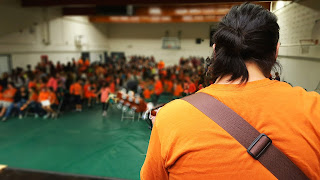
Yesterday, I tell the editor, I experienced a highlight on my Treaty Walks. We shared an Orange Shirt Gathering at our school. One of my adult students, Michael Cardinal, in Oski-pimohtahtamwak otayisīniwiwaw (they are into their new journey to knowledge) closed our gathering playing Led Zeppelin's "The Rain Song" because the sun will shine after the rain or storm, he told us.  


One assumption for me in working in Treaty Education is that it is easy for educators to understand how important it is to show up at events where indigenous peoples are offering us gifts, Treaty gifts of miyowîcêhtowin (getting along together); pimâcihowin (making a living on the land); wîtaskêwin (being one with the land) and wâhkôhtowin (practicing our kinship). For example, bringing students to the Treaty Four Gathering in Fort Qu'Appelle, in the week of September 15 each year, should be easy. I see now, this is an assumption, but it does get easier, I'd like to tell people. Once you've been there once, you'll understand how to come back the next time. But the first thing is to just go, is to show up, as I remember Dr. Shawneen Pete and Dr. Mike Cappello reminding us at the 2014 SAFE conference. Sheena August, Prairie Valley School Division communications officer, and I had great discussions about the importance of experiencing something before understanding. Sheena (we had so much fun being two Sheena's) got right into the spirit of things, working with Arwen to get the tipi pole back in the flap as she had been shown to do earlier, if it slipped out.

The most important thing for me on my Treaty Walks is to remember that Treaty is about relationships, and relationships need opportunity, time, nurturing, sunlight, rain, and wind to grow. Treaty Walking is not a checklist of activities on a bucket list. It is going about regular life, being mindful of the great gifts and opportunities envisioned in the Treaties. I'm thinking about running into Daya Madhur and Claire Krueger at the Treaty Four Gathering, and there they were, going about their lives, huge smiles, cameras slung around their necks, backpacks ready for a day on the land as Treaty people, as Treaty educators.


My most awkward moment since we last met... oh there are so many. It might have been trying to get a good picture of His Excellency David Johnson, Governor General of Canada as he visited Treaty Four Grounds for the first time in his life, and was the first representative of the Queen to return to meet with the crown's treaty partners in 142, since the Treaty was signed. I had to dodge security, media, well-wishers, and handlers. I did get a few with him talking with my friend, Maddie Sanderson. I also helped arrange that my husband, Michael's grade 12 Canadian Studies class was able to witness the nation to nation speeches and meeting, but that wasn't really awkward. Now I'm just bragging.


"Well, now I have something to work with," says the editor. "But what about our next episode? Let's do an A-Z brainstorm for Treaty Walks."

Awkward
B
C
D
E
F
G
H
I
J
K
L
M
N
O
P
Q
R
S
T
U
V
W
X
Y
Z

Sunday, September 11, 2016

Feast Kit for Monday Afternoon

Imagine spending the afternoon sitting on a blanket and enjoying time with women, or if you're a guy, sitting with other men, and sharing a meal, served by young men in our community. Imagine this circle, together as Treaty people, accepting the gifts we have to offer one another as good neighbours.

If you've never been to a traditional feast before, why not join us on Monday at noon, on the Treaty Four grounds.
  • Bring some food to share. One of the following would be great: soup, fruit, bannock, juice boxes (please deliver by 11:45 to the announcer’s booth set up area).
  • Bring a feast kit: carry away bag, multiple size plastic containers or jars with lids (for eating and take away), spoon, fork, knife, serviettes, plate, wipes if you like.
  • Blanket to sit on or a chair if you are elderly or unable to sit on the ground. 
  • Women, wear long skirts or wrap around and do not sit crossed legged, but with knees to the side.
  • Selected young men will serve the food until it is all distributed.
  • Women sit together on one side and men sit together on the other side.
  • Women on their cycle (moon time) are asked to sit outside the circle to respect their power.
Here's a picture of my feast bag:


FEAST KIT:
  • Carry away bag,
  • multiple size plastic containers or
  • jars with lids for (for eating and take away),
  • spoon,
  • fork,
  • knife,
  • serviettes,
  • plate, and
  • wipes if you like.
  • Blanket to sit on.

Saturday, September 10, 2016

Empowering Women: Weaving Stories, Inspiring Action

  • To listen to stories of families directly affected by Missing and Murdered Indigenous Women and Girls
  • To weave stars in honour of Treaty Four women to add to the One Million Stars to End Violence Project. www.onemillionstars.net
  • To generate ideas to send to the National Inquiry into Missing and Murdered Indigenous Women and Girls
Monday, September 12th
6:00-9:00pm
Large Teepee at the Treaty 4 Governance Centre
Fort Qu'Appelle, SK
 
Appetizers by the Sioux Chef
 
All Welcome by invitation of the
Faculty of Education at the University of Regina.
 
Come for the Feast at Noon.
Relax the afternoon away in the valley.
Join us for Monday evening's conversation. 

Friday, September 9, 2016

Analyze the Overall Effectiveness of the Blanket Exercise Presentation: ECS Students Reflect

For Aboriginal Storytelling month last February, four students from Bert Fox Community High School were invited to the Estevan Comprehensive School to present the Blanket Exercise which tells the history of Canada through the voices of indigenous peoples. The blankets represent the land and participants play the role of sovereign indigenous peoples. The facilitators play the role of Europeans who first come to the land as friends, but as the power begins to shift, and Treaties are broken, assimilation and colonization become a reality.  http://kairosblanketexercise.org/about


Tim Lee and James Jones, teachers at the Estevan Comp, assigned reflection questions. This is the last of five questions asked.

Analyze the overall effectiveness of the presentation.
  • The presentation is both visual and verbal. That's twice the effectiveness.
  • The overall effectiveness of this presentation was that it makes you stop and think about how we never hear about what happened to the Aboriginal peoples. Kind of like it's Canada's dirty little secret.
  • The presentation was an eye opening experience.
  • To me this presentation was very effective. Many people are visual learners and learn by being involved. This is what made the presentation so effective. After being involved I have become more aware of how poorly First Nations were treated. With the Blanket Exercise it made it clear that they were pushed off the land and sent to Residential Schools. By standing on the blankets and having them become smaller as the years went on shows the little room they had.
  • They could have read slower.
  • I think the presentation had a large affect on those who listened and cared. However, I think quite a few didn't care and weren't interested at all, and in those people the presentation fell on deaf ears. In everyone else, myself included, it educated us about the feelings of the First Nations. No other devices used to teach at schools can make you feel what it would even slightly have been like, and the blanket exercise did. That feeling of understanding makes you care more about it, and when you care about a topic, it makes you want to learn about it, to do something about it. And that's what I think this presentation made people do, care.
  • To me the overall effectiveness was great because everyone was mature, everyone was in a serious stage, listening to what actually happened in our world, maybe not our lifetime, but our grandparents and even parents. Racism was a big thing to the Aboriginal peoples and it is still going on today. It was hard to hear some of their stories, but in general, they got through it and made us more aware of what was going on around us. They were very educated about the topic. They genuinely cared about the topic and showed that they wanted to get their story out to us. They were passionate and well educated about their topic. They got their point across very well by using hands on activities and I was more into it because it was hands on and not reading from a textbook.
  • Very well thought out. They were well prepared, rehearsed a lot. You could tell because they had lots of writing on their scripts. It would be effective for grade eights because it was powerful. They were not scared to yell and get the point across. I give them credit for doing the presentation in front of three classes of kids their same age.
  • Overall it was about a 4 out of 5. It does teach you a thing or two, but in my opinion, all Native Study activities are focused around the same thing. Though this was by far the most interesting and interactive presentation I have attended. there's lots of people that need to be included in order to learn, and I feel that this is a very good teaching method, especially at a high school level. It's also effective because those who were presenting were of the same age group which was nice for a change. Much better than a corpse talking for a droning hour.
  • I felt that the presentation was very effective as it caused me to critically think about what I could do to inspire action. It made me also realize how ignorant I can be about cultures other than my own. I also felt that the fact that the presenters were youth like us made the presentation more effective. It made it easier to understand as well as easier to relate to. I also felt that since the presenters were our age, I found that it was easier to pay attention to them as I understand how hard it is to stand in front of a group of peers and present. Lastly, I found that the use of visuals in the presentation made the information easier to understand.
  • Overall, the presentation was amazing in the sense of effectiveness! The fact that they had us participate not only as standing on the blankets being "natives" but they also had us read scrolls about the history of it all. They engaged us very well and really helped us visualize how traumatic and REAL the situations were. I took in a lot of knowledge that I hadn't known prior to the presentation and the fact that they were all our age made it even better. I wouldn't change a thing about the presentation.
  • If the girls made us sit on the bleachers and listen to them talk, then I can assure you that most people would be on their phones. The girls seemed to be very passionate on the subject because as they said, it's our shared history. I can tell that our presenters really did enjoy doing this.
  • I think the overall effectiveness of the presentation was moderate. For people, such as myself, who are uncomfortable in tight groups of people, I found myself unable to maintain focus as I was too busy trying not to bump into someone. I believe that getting the audience involved is a great idea, however, many people are unwilling to speak in front of their peers and because of this, I was unable to hear what people were reading off of the scrolls. Other than those two points, the presentation was effective. I understood what information I received.
  • The overall effectiveness was very powerful in different ways like when they gave me the baby, and I held it for a while, then they took it away. I felt a bit sad. If that were my real baby, and it got taken away, I'd be heartbroken. Everything that they read actually happened (not to them necessarily) but to their people. We learned that just because it didn't happen to us doesn't mean it didn't effect us in a way. Considering it was presented by our peers made it more understandable from their perspectives.
  • I think the Blanket Exercise was very effective because it went over a lot of information in a short amount of time. They used information that was easy to understand. They had everyone participate and play a role. The only thing I didn't like was how fast they spoke and I couldn't really understand them sometimes.
  • The presentation was extremely effective. One of the major ways it was effective was it was done by grade elven and twelve students. It wasn't just someone rambling on and on. We were asked to participate, too. When they began to make the blankets smaller you started to really see and feel first hand what they went through. It almost made you realize your "life was at risk" to be kicked off the blankets and "die". After the presentation the leaders were able to speak and the girl in my group was able to share some of her own experiences as part Aboriginal. That really shows that you can't judge a book by it's cover. Overall the presentation was just awesome to experience.
  • This presentation is effective because you don't sit for an hour and listen to facts. You are moving around and acting out the things that actually happened. You see what happened and you get a very clear picture of it because they put you in their shoes and move you around and take land and then send you away and take babies then all of a sudden people die off. As well they were very passionate about the topic. They made you play along and play a part in it to help you learn and understand. They were always moving around and walking around the circle.
  • The presentation was a lot different than I expected it. I expected us to just sit on the blanket and listen to stories told by grade 12's. Instead, we were included in the presentation and got to read the Treaties and the laws that the European's implemented on the Aboriginals. We were given papers, and when you had a certain colour paper you could be killed by smallpox or other disease brought by Europeans. Many were killed and their children (baby dolls) were taken to Residential School. I believe that grade 12 students presented this to us gave it more of a personalized feeling. You were yelled at  by one of the girls pretending to be a European and it actually scared you a little. It was nice having it put into a real situation, not just having it read to you. This way you got to partake in the storytelling and it was really enjoyable. It was serious and yet intriguing, waiting to find out who dies next. Personally, I don't think it would be as effective on elementary (6, 7, 8) grades because they aren't mature enough to understand the seriousness of the situation. The language is harder and it could need to be adapted to their form of understanding. I believe that the presentation was very effective and influenced a great deal of the group.
  • This was a very effective presentation. It gave us a chance to participate and a small chance to see what it was like. It was also good to see that it was people our age presenting, proving that we can make a difference and pass this information along and make the future better.
  • I believe that the presentation was effective because it got us involved and made us see how poorly First Nations were treated. It opened my eyes to see how the people were treated and made me think of ways to fix our relationships.
  • The effectiveness of the presentation is actually quite a bit. It's not making me go out and donating money to First Nations people, but it really puts our past into perspective. Although it's not nearly as intense as it would have been for when it happened, but it is at a nice scale where people can take it in and realize what happened. The Blanket Exercise is something I will never forget and when people ask about what happened in our nation's past it will now be easier to explain and easier for them to learn.
There were a few sheets with comments like, "We could have learned more in class. It was a normal presentation to me. Honestly, I learned nothing. None of it was emotional to me. This did not inspire me. Some of it may inspire and others it may not. It didn't really have any effect on me."
 
But as you can see from the responses above, it was overwhelmingly well-received and an optimum educational experience for all involved.


Note. Excerpts from the ECS reflections on the Blanket Exercise can be found on Treaty Walks question by question on the following dates:
 
1. What was your general impression or thoughts about the Blanket Exercise? Did you enjoy participating? August 14th, 2016
 
2. What did you learn from Friday's presentation? August 23rd, 2016
 
3. What was the most emotional moment for you? Why was it emotional? Consider the speaker's values, perspective, biases and tone. August 29th, 2016
 
4. The Blanket Exercise is designed to inspire action. How could an event like this inspire people? What could we do? September 2nd, 2016
 
5. Analyze the overall effectiveness of the presentation. September 9th, 2016

Thursday, September 8, 2016

Just Like Our Grandmother: Help from Elder Alma


Truth, Jerrett (JJ), Sebastian (Shorty), Sheena, and Ashton with Elder Alma


"We were honoured to have Elder Alma in our class," says Truth. "I learned a few things about sweetgrass and smudging, and what you're supposed to do with it after you're done using it. You take all the ashes and put them somewhere in your environment that's really quiet. I felt really good and happy when Elder Alma was with us because of the sudden deaths we have experienced. I will remember our class because it's the best class I've had so far. When Elder Alma said her own language, it made me feel like everyone should learn their own language. She reminded me of my grandmother. She's exactly the same, I think."

"We were honoured to have Elder Alma in our class," says Jerrett. "I learned a lot of different things that day about Residential school, my culture, and not only just my culture. She said a lot about the Europeans and such, meanings about life and it was a pretty good feeling to have."

"We were honoured to have Elder Alma in our class," says Shorty. "I learned about certain medicine, how to treat them, and how to thank them after you are done using them. I felt comfortable when we spoke with her as if she was my own grandmother. I will remember all the stories she told us and the teachings she left with us. She reminded me of my grandmother who passed away, just how sweet she was, along with her wise words."

"We were honoured to have Elder Alma in our class," says Sheena. "Since the beginning of the school year, we have learned of three deaths of former colleagues. One of the women worked very closely with some of us, and we were looking forward to working with her this year. The other woman and her husband had worked with many of us, closely, in the past. Our school is grieving, so Elder Alma agreed to come and help us in this difficult time. She led a smudge and a talking circle for any staff or students who wanted to participate. She came back with us to our room. I'll always remember how she told the young men that she was so proud of them, that they were like her grandsons. She said that when older people see young people, so respectful, learning what they need to learn, that they make the old people so happy."

"We were honoured to have Elder Alma in our class," says Ashton. "I was actually grateful to her for teaching us how to handle the sweet grass and sage after we were done. It reminded me back in the days when she used to teach me Cree. She asked me to read some Cree words, and I kind of got it. It was very good to see her again, because I haven't seen her in a while. After the smudge, it made me feel more open minded. It made me feel good."

Tuesday, September 6, 2016

Pimātisihwin / Kiskinohamāsowin

It's not every day that you get to sit beside an elder and record her thoughts as she creates an English literacy program for adult learners as one of the requirements in her university class as she works on her Masters of Education. For me, in late August, I was honoured to be Kete-ayah Alma Poitras' secretary for four days. it was four days. Occasionally, she would begin storytelling. I felt like I was sitting on the edge of her worldview -- not my own -- and seeing, listening, smelling, tasting and touching with my own senses.

With Alma's permission, I will share her introduction.


"Introduction" to "The Interconnectedness of Pimātisihwin / Kiskinohamāsowin: Level One and Two Literacy for First Nations’ Adult Learners"

by Alma Poitras

"I am a First Nations Educator from Peepeekisis, one of the five File Hills First Nations. File Hills is also known as Kiskimanacihk in the Plains Cree language. My goal for the future is to create a program that will meet, both the First Nations Cree literacy skills and their English literacy skills. For this assignment I will only focus on the Low Literacy needs in English for the group I have chosen to create the program for which is First Nations Adults from File Hills and particularly young parents, both male and female, ages ranging from 19 to 35 years.

"Pimātisihwin / Kiskinohamāsowin means how an individual or person goes about gathering knowledge and learning throughout their lifetime, and putting these experiences, and using these experiences in teaching themselves. It is a contextualized learning with the learner in the centre, with all the other aspects that come to make that learning possible for the individual. It’s all those experiences, gathered throughout their lifetime, or as they grow from infant, youth, adulthood and kētēh-ayak (old ones) getting knowledge which makes it possible to make meaning. This helps the learner to be successful. There is a continuation of adding from prior knowledge which helps increase many possibilities of doing and improving different level of needs of that individual’s four aspects of their inner self: mind, physical, spirit, emotional. We learn from things around us, in our First Nations’ perspectives, we learn from nature, from the animals, from the flyers, from the swimmers, from the four legged, the medicines, the elements, the sky-life and the earth, and also the two-legged. You cannot live without going about and learning from your surroundings. You are learning to make a better life for yourself, your family, and your community. This is Pimātisihwin. Life is possible because of using all the resources that are there for us."


As I typed Alma's thoughts, they directly related to the new program I am developing at my high school. In the background of our "selfie" you can see the beginnings of my unit plans focusing on the Treaty Four Gathering in Fort Qu'Appelle, September 12-18, 2016.
 
I hope to utilize Pimātisihwin / Kiskinohamāsowin as my students and I go about gathering knowledge from all around us. I hope we are able to share what we are learning with all we meet. I also want to thank Kete-ayah Alma for her generosity and teachings. 

Monday, September 5, 2016

A Conversation with a White Elder: Anonymous Awakening


Hi Sheena. This will be a bit of a ramble...I read your lovely gentle blog this morning...the discussion of racism and privilege goes around and around in my brain. It started with my own upbringing in the late 40s and early 50s...one of total ignorance of Aboriginal people. The only "Indians" I ever saw were at the Regina exhibition where they had a row of tipis...then, as a teenager as a kid at the beach. I vaguely knew a of residential schools. So, essentially I was ignorant and indifferent. In the 80s I knew two families who had "scooped" children and the resulting problems associated with these kids as they became adults. Again, ignorant and indifferent. During my years working in the arts, the artists, especially Bob Boyer, and curator Lee Ann Martin were instrumental in opening my eyes. It was more of a spiritual perspective that they gave me. Invaluable. But, I didn't acknowledge or even know that white privilege existed until the Truth and Reconciliation process began. I do now. I understand it. It is a process for me. Baby steps. I have to let go of many things...we/they, fear, old attitudes, my own shame for not knowing, not caring while these people endured so much. Keep writing. Be patient with me! I'm listening. Thank you.

Absolutely beautiful, J. Would you be interested in me publishing this on my blog as a letter? I think we need to hear from our newcomer elders, like you.

I have no problem with that...but please don't use my name. Simply because it's MY process...my journey...and intensely personal. I haven't been able to have this conversation with very many people...they don't want to hear it. I've lived 70 some years with a flawed perspective. And at this point I'm not very happy about that. I'm asking you to take my hand. Walk with me.

I'm very happy to do so. We could record these conversations anonymously, so others, who are also feeling the awkwardness in the newness-of-it-all can read your words and know they are not alone. I'm happy to have these conversations privately, too. Thank you for your trust in me as you share these deeply personal awakenings.

Thanks Sheena. Keep writing. I'll keep rambling. Lurching. Finding my footing. Thunder. A weekend with family. Summer's almost over... Let's enjoy every moment...even if it rains!

Well said. I always tell people, "Go forth and be awkward." I think your rambling and lurching has a lot of poetry going on, too.


Sunday, September 4, 2016

You are Invited to the Treaty Four Feast on September 12th


Preparations are in full swing for the Treaty Four Gathering
September 12-18, 2016
 
You are invited to the Treaty Four Traditional Feast
Monday, noon, September 12th
Treaty Four Pow Wow Grounds

We are all Treaty people.
 

Never been to a Traditional Feast? Here's what you need to know:
 
  • Bring some food to share. One of the following would be great: soup, fruit, bannock, juice boxes (please deliver by 11:45 to the announcer’s booth set up area).
  • Bring a feast kit: carry away bag, multiple size plastic containers or jars with lids (for eating and take away), spoon, fork, knife, serviettes, plate, wipes if you like.
  • Blanket to sit on or a chair if you are elderly or unable to sit on the ground. 
  • Women, wear long skirts or wrap around and do not sit crossed legged, but with knees to the side.
  • Elders can bring a chair, if needed.
  • Selected young men will serve the food until it is all distributed.
  • Women sit together on one side and men sit together on the other side.
  • Women on their cycle (moon time) are asked to sit outside the circle to respect their power.
 
If you have questions that I can answer (from a newcomer’s or educator’s perspective), feel free to email me, sheena.koops@pvsd.ca or call at Bert Fox Community High School 306.332.4343.
 
Note: Invitation sent in consultation with Tracy Pasqua, Chair of Treaty 4 Gathering Events.

Saturday, September 3, 2016

How Does a Saskatchewan Farmer Honour the Treaties?

My brother, Ian, proud sheep farmer for two years.


I grew up on a farm in Saskatchewan, and I am proud of my heritage. Many farming families came to this land, opened by Treaties, escaping oppression. I have always thought that as farming-folk learn of the oppression -- the genocide -- experienced by First peoples, there should be a natural solidarity between our peoples. I have heard stories of this being the case, of our peoples being good neighbours.

Mae Wesley, a settler descendant elder in the Edgely farming community which neighbours Pasqua First Nation, told me that her dad always said, "If you make a friend with an Indian, you have a friend for life." My own father's grandmother, as a late 1800's bride in the Estevan area, received half a deer, cleaned and hanging in a tree. A gift from her Indigenous neighbours.

On the other hand, what can I say to fellow farmers utilizing the tragedy of August 9th in Biggar, Saskatchewan, as an opportunity to illustrate ignorance. Ignorance of the Treaties, ignorance of privilege, ignorance of colonization, ignorance of genocide, ignorance of the gifts we have been given by the First peoples of this land?

When I heard that the councilor who resigned (after making blatantly racist remarks on social media) was from Lampman, where I was born, I knew I needed to reach out. While visiting my kids in Estevan, I almost drove to Lampman to see if I could find the family. My daughters insisted that it wasn't the right time. Instead, I phoned the National Farmers' Union. I wanted to speak to whoever wrote the press release extending condolences to the Bushie family and condemning racism. "We also commit ourselves to building relationships of solidarity, mutual respect, and friendship with our indigenous neighbours, and honouring our obligations as Treaty people," the NFU concluded.

I spoke with Cathy Holtslander from the National Farmers Union. I thanked her and her organization for their leadership. I asked what actions they intended as they make good on their commitments. We talked for a while, sharing ideas back and forth, and good books kept entering the discussion. Thomas King's Inconvenient Indian: A Curious Account of Native American People in North America; Sarah Carter's Lost Harvests: Prairie Indian Reserve Farmers and Government Policy; James Daschuck's Clearing the Plains: Disease, Politics of Starvation, and the Loss of Aboriginal Life; and Paulette Reagan's Unsettling the Settler Within: Indian Residential Schools, Truth Telling, and Reconciliation in Canada.

This conversation, has got me thinking. What does it mean to be a farmer? What is my farm family's Treaty story? From which Treaty promises have my family benefited? Have Treaty promises been kept to our Indigenous Treaty partners? If so, what are those benefits? If not, why? How does a Saskatchewan farmer honour the Treaties?

http://www.nfu.ca/story/nfu-expresses-condolences-family-colten-boushie


My neice and their Llamas (named Sheeps and Momma).

Friday, September 2, 2016

How Could an Event Like the Blanket Exercise Inspire People? ECS Students Reflections

For Aboriginal Storytelling month last February, four students from Bert Fox Community High School were invited to the Estevan Comprehensive School to present the Blanket Exercise which tells the history of Canada through the voices of indigenous peoples. The blankets represent the land and participants play the role of sovereign indigenous peoples. The facilitators play the role of Europeans who first come to the land as friends, but as the power begins to shift, and Treaties are broken, assimilation and colonization become a reality.  http://kairosblanketexercise.org/about
 
 
Leeza, Eraine, Mercedes and Tomika
BFCHS students lead Blanket Exercise at ECS
 
 
"Events like this inspire people because as the girl said, 'it's our shared history.'"
 
 
Tim Lee and James Jones, teachers at the Estevan Comp, assigned reflection questions. This is the fourth of five questions asked.

The Blanket Exercise is designed to inspire action. How could an event like this inspire people? What could we do?
  • An event like this inspires people by teaching them about what has happened in the past. We could now continue to pass down the information we learned.
  • By folding the blankets we see what is the lives of indigenous peoples. An event like this inspires people because then they visualize what had happened to the Aboriginals and that what they went through is still a reality to most. We could stop saying they should get over it because that's like saying to the families who died in concentration camps to get over what happened and move on.
  • It could inspire people to become more informed about the issues of First Nations people and to take more or any action about it. WE could do any number of things; educate more people, raise money, raise awareness, demand more from our government for their rights. However, I believe the most important thing would be to be more compassionate, understanding and be less judgmental and prejudice.
  • It could inspire people because people could look at them and wonder why they're so happy now. Well, the girl leading my group says that she didn't have a choice but to be happy because as she grew up she had her family with her and her family really helped through the rough patch of her life. It already does inspire people because it shows that something needs to be done and everyone needs to be treated fairly. We owe something to the First Nations for what they have been through.
  • It exposes the terrible fat on what the Europeans did. It kind of leaves you feeling like, wow, that kind of sucks that we just invaded them. But at the same time, what's done is done. I know nothing of a solution to how to resolve it.
  • We could do the Blanket Exercise with other classes or even kids in elementary school. I know that if I would have been able to do this visual and interactive exercise when I first learned about First Nations history, it would have helped me to truly understand what happened. This could inspire people to stop being ignorant about Aboriginal culture possibly.
  • The event itself is very inspirational, not in a sense of that you can do anything, but in the sense that it might push people to change their opinion and attitude towards things. If you were completely ignorant to the bad things that happened, then this exercise could change your viewpoint on natives. We in turn could spread awareness to stop racism and just help people understand what has happened in our history.
  • It's designed to teach in a way we understand. Events like this inspire people because as the girl said, it's our shared history. We don't have to do anything big, a simple conversation on the topic would be enough.
  • The Blanket Exercise could inspire people through a physical learning environment, getting people involved almost cements the ideas taught into someone's mind. To inspire people we could promote more people to do similar exercises at our school every year.
  • An event like this could inspire people to take this to younger schools and introduce it to the younger generation.
  • An event like this could inspire people by showing them what actually happened and how hard things were. Now that people know what happened, they can help others understand and then stereotypes might stop.
  • It could inspire people to quit being racist and quit thinking that they are better than everyone. We could make sure everyone is treated equally and no one gets bullied or treated badly.
  • It could inspire people to look into their heritage and see if they are Aboriginal, if they don't already know. It could inspire people to get involved in groups that support the Aboriginal people and take action. We could continue to have this presentation in schools and maybe provide it for adults to experience too, so that everyone understands what the people went through.
  • An event like this can inspire people because it is showing them what actually happened so that they know what they are supporting.
  • They could realize that sometimes just raising money doesn't fix all of the problems. People need to see a presentation like this from young people.
  • When we learn about Aboriginal history it's usually just brushed over. This Blanket Exercise inspires us because we see that we were a part of their fate. We can help change this by personally stopping racism against Aboriginal peoples. Racism causes many people to doubt their worth. We can be friends with people that are experiencing criticism from peers. It could encourage people to go to support groups and find out if they have an Aboriginal heritage.
  • It inspires people by putting people in their shoes. It's much easier to fight for a cause if you know how it felt. There is no substitute for what they went through but since we now have a better understanding of the full effects of it, we can tell people about it and spread the word so they can get back the land they deserve.
  • The Blanket Exercise inspires people because the presentation involves everyone. When you're involved you are learning and aware of what's going on. Since we weren't there at the time that this occurred in real life, the Blanket Exercise has the same impact, bringing awareness.
  • The Blanket Exercise could inspire people by showing them how it felt to be Native back when the Europeans came to North America. This would inspire them to help out Natives instead of keeping them segregated from our society. I honestly can't think of anything we could do besides treating them well and like normal people.
  • It could inspire people to want to change the world and the relationship between First Nations and the people who stole their land.


Note. Excerpts from the ECS reflections on the Blanket Exercise can be found on Treaty Walks question by question on the following dates:
 
1. What was your general impression or thoughts about the Blanket Exercise? Did you enjoy participating? August 14th, 2016
 
2. What did you learn from Friday's presentation? August 23rd, 2016
 
3. What was the most emotional moment for you? Why was it emotional? Consider the speaker's values, perspective, biases and tone. August 29th, 2016
 
4. The Blanket Exercise is designed to inspire action. How could an event like this inspire people? What could we do? September 2nd, 2016
 
5. Analyze the overall effectiveness of the presentation. September 9th, 2016